MIRA — a conversational commerce MVP for fashion ecommerce
An MVP exploring how fashion ecommerce can turn natural-language intent into relevant product recommendations through conversation, context and real catalogue data.
problem
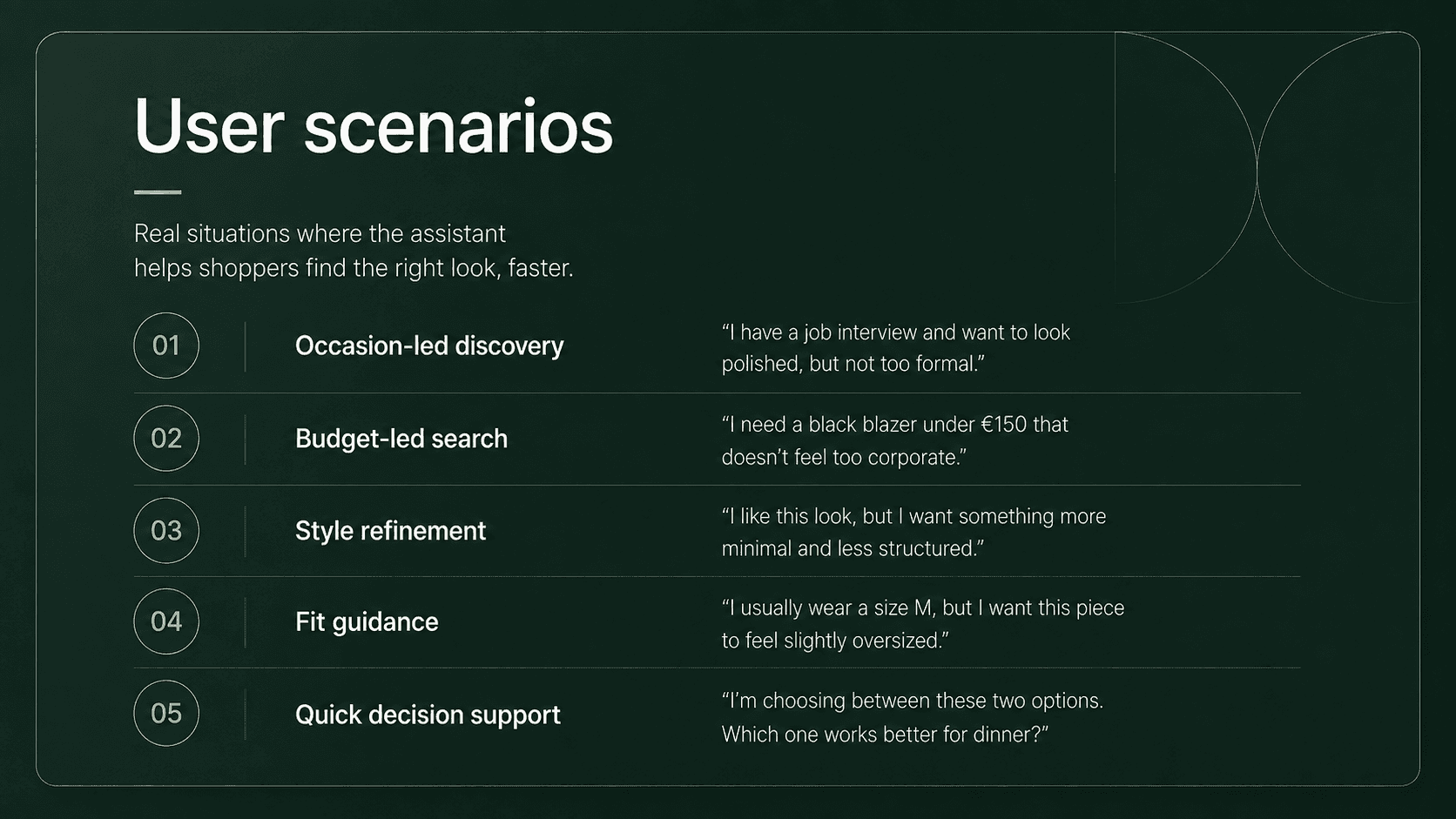
Online shopping often asks users to translate an imprecise need into filters, categories and search terms before they even know exactly what they are looking for. That works when intent is clear. It becomes less useful when the need sounds more like: “I need something for a job interview that feels professional, but not too corporate.” The goal was to explore how AI could support better product discovery without turning the experience into a traditional chatbot.
solution
MIRA is a voice-first shopping assistant designed to turn natural language into relevant product recommendations. It combines conversational input with product retrieval, clarification and refinement, helping users move from a vague need to a smaller, more useful set of options.
Context
Fashion ecommerce is still largely organised around categories, filters and search.
But shopping intent is often much less structured — people think in situations, preferences and constraints rather than product taxonomies.
MIRA explores how natural language could bridge that gap between intent and product discovery.
Hypotheses
1. Users shouldn’t have to translate intent into filters.
Natural language can capture context that traditional search often misses.
2. Relevance matters more than catalogue breadth.
A smaller, better-ranked selection can be more useful than more results.
3. Refinement should preserve context.
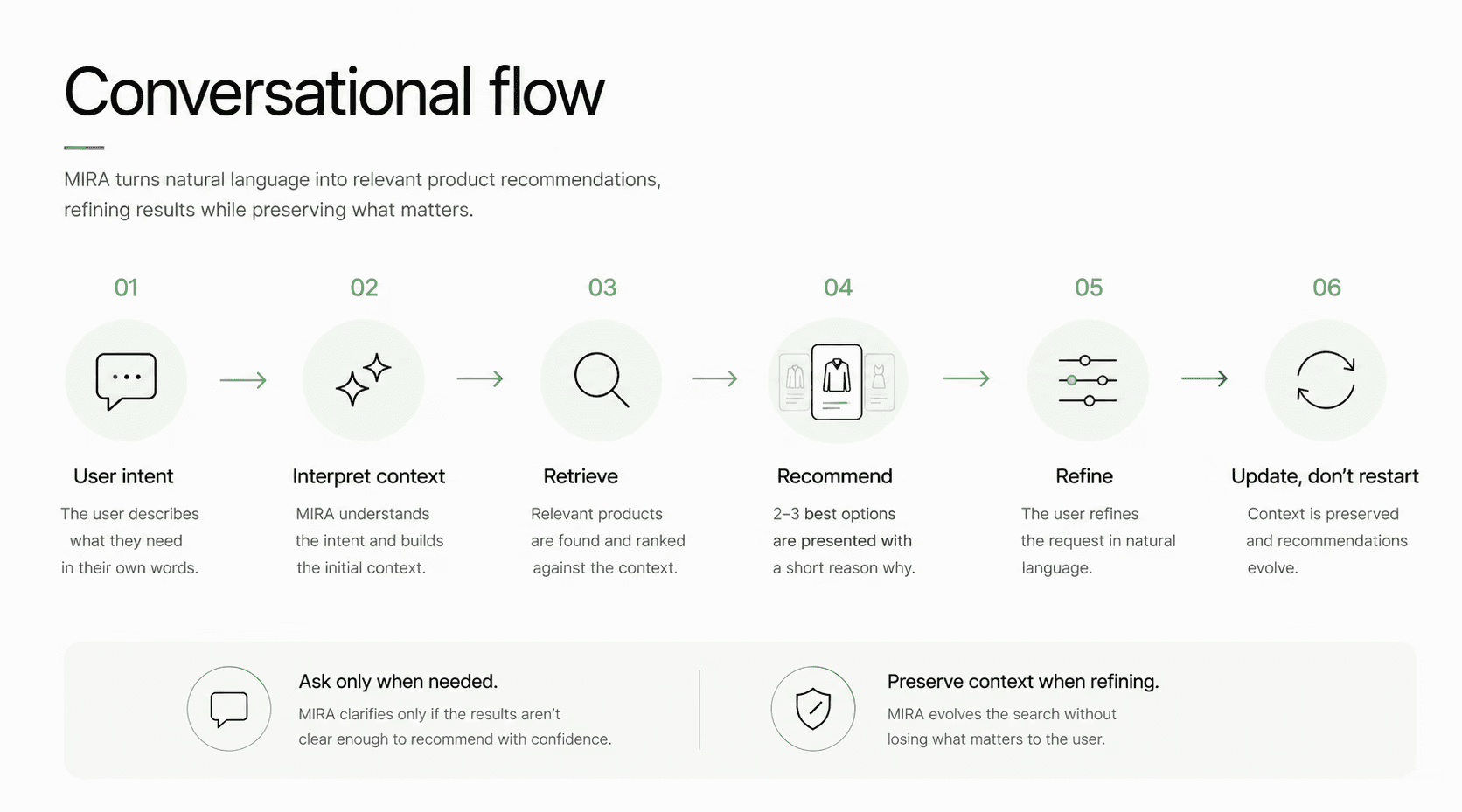
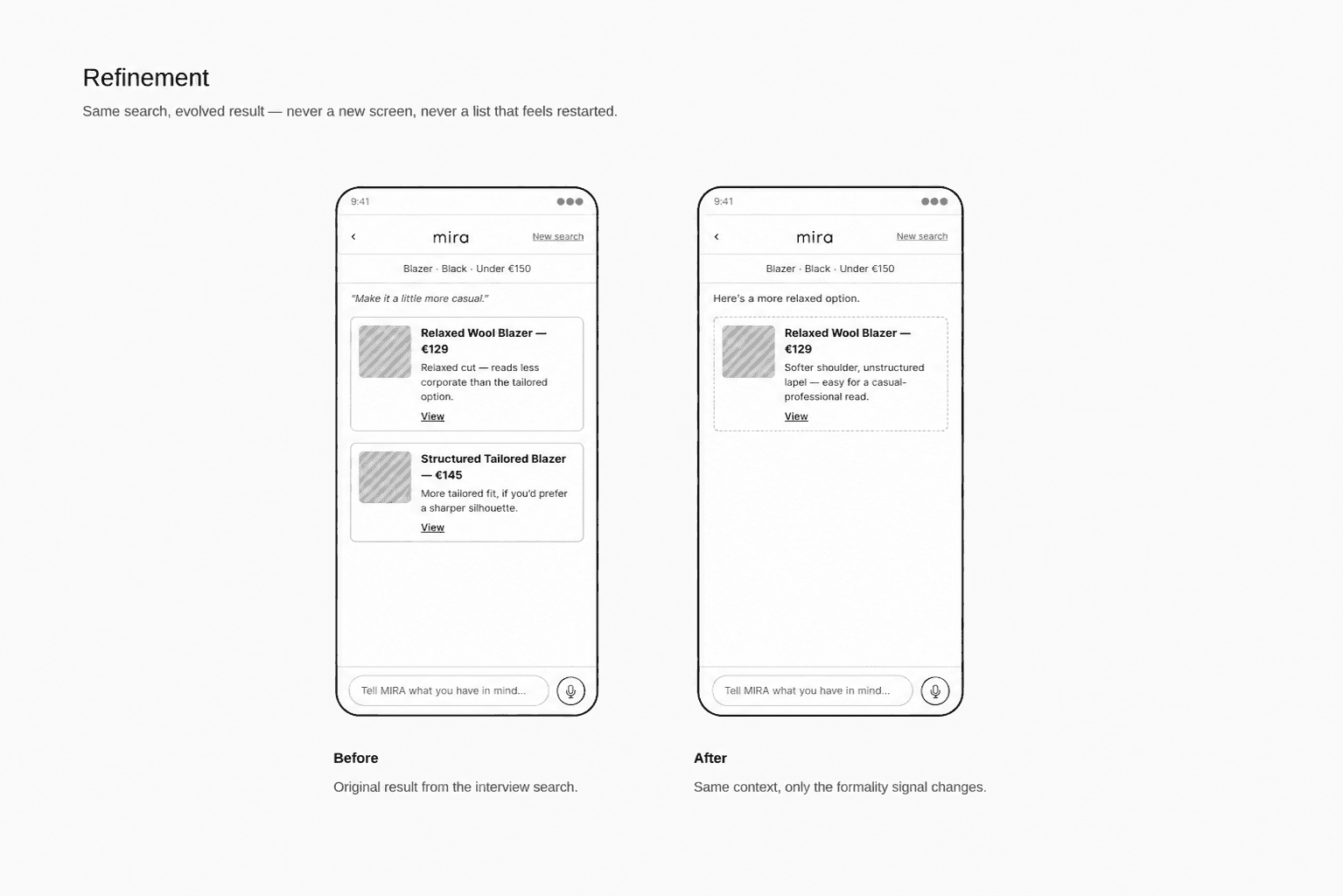
Requests like “more casual” or “cheaper” should evolve the current search, not restart it.
Intent & context model
MIRA does not wait for every detail to be explicitly provided. It interprets the user’s goal, identifies the signals that matter, and decides whether it has enough context to recommend or needs one clarifying question first.

Product data model
For conversational discovery to work, the catalogue needs to describe products in the same terms people naturally use — not just category and price, but also fit, formality, occasion, style and intent.

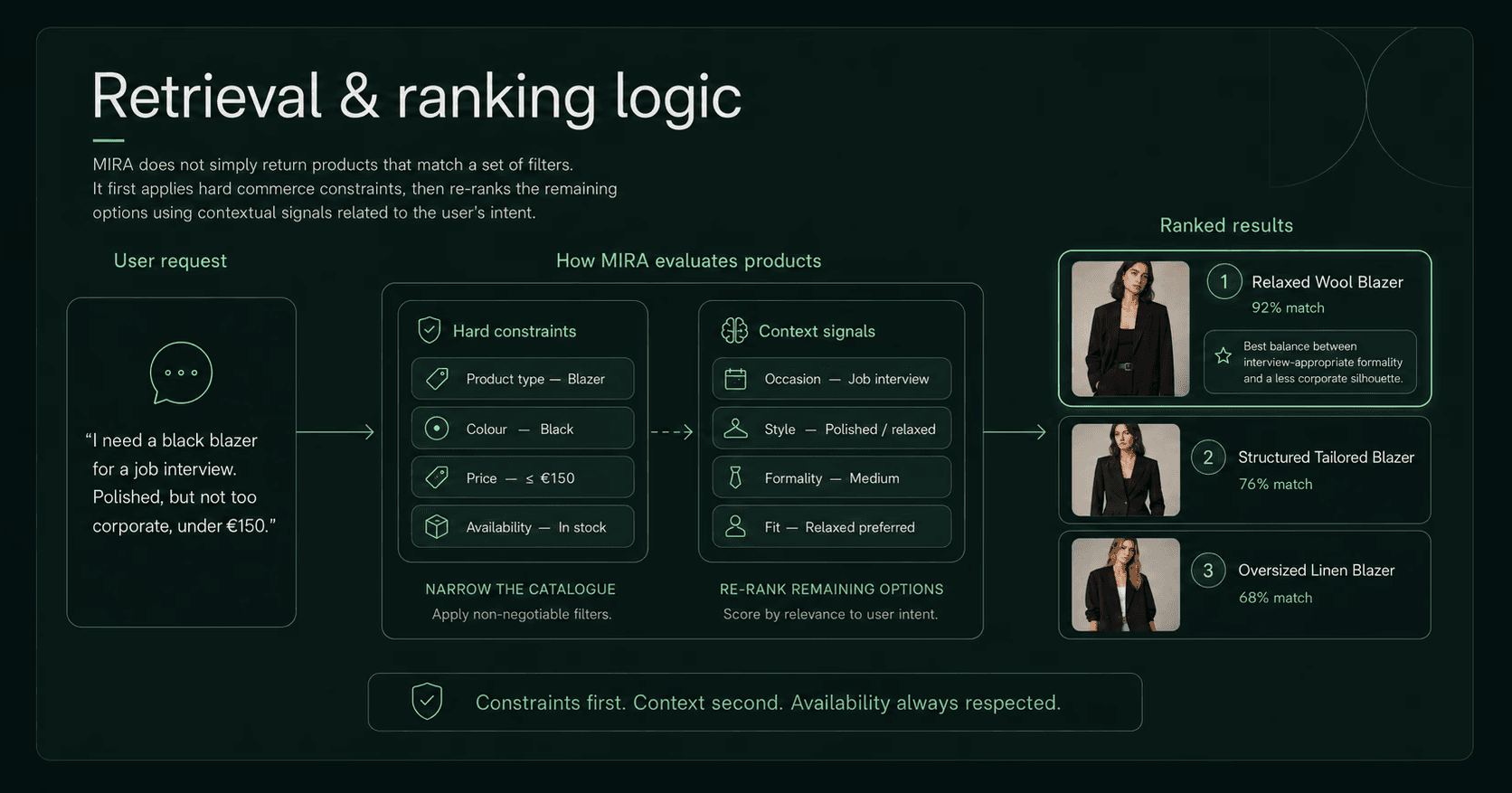
Retrieval & ranking logic
MIRA does not simply return products that match a set of filters. It combines hard constraints with softer contextual signals to rank the options that best fit the user’s intent.
From conversation to interface
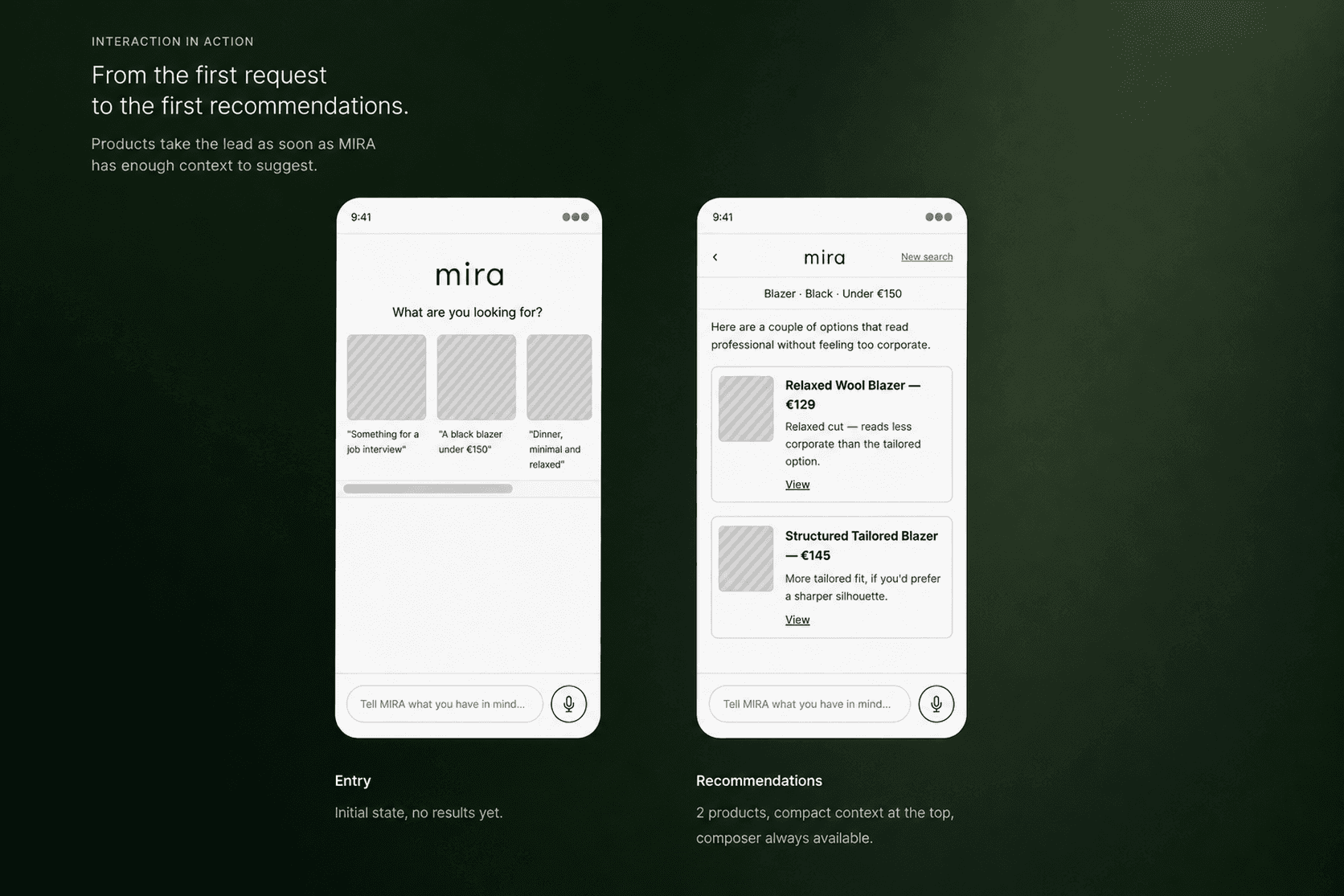
I translated the conversational model into a responsive set of interface states built around one principle: once MIRA has enough context to recommend, products should take over the experience.
Conversation remains available throughout the journey, but it never becomes the interface itself.
Refine, don’t restart
Refinement updates the current search rather than starting over. Hard constraints stay in place, while softer preferences can evolve as the user refines what they want.
Ask only when it helps
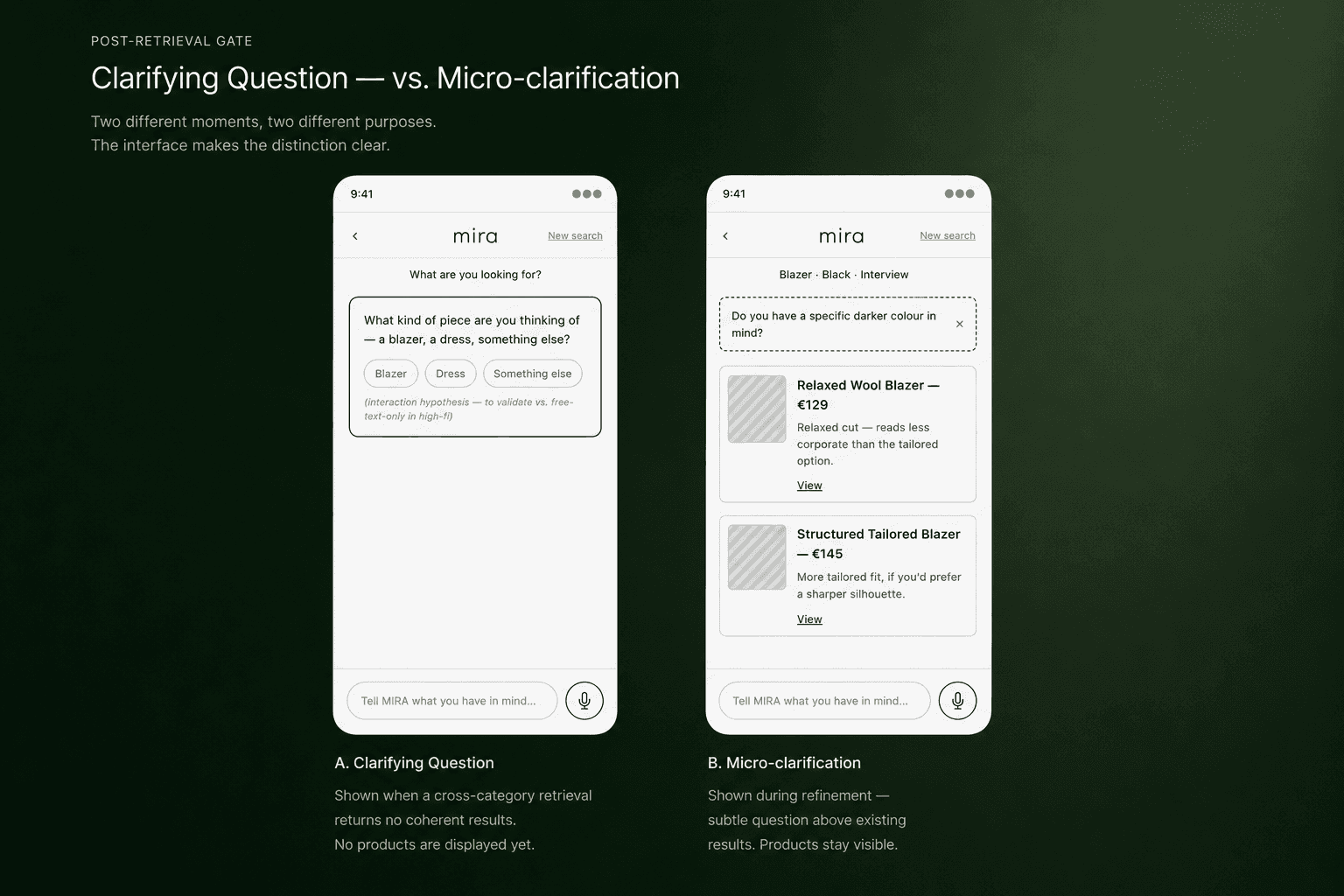
Not every clarification should interrupt discovery.
MIRA distinguishes between questions that are necessary to produce a useful result and lighter clarifications that can happen while keeping products on screen.
HIGH-FIDELITY UI
From interaction model to interface.
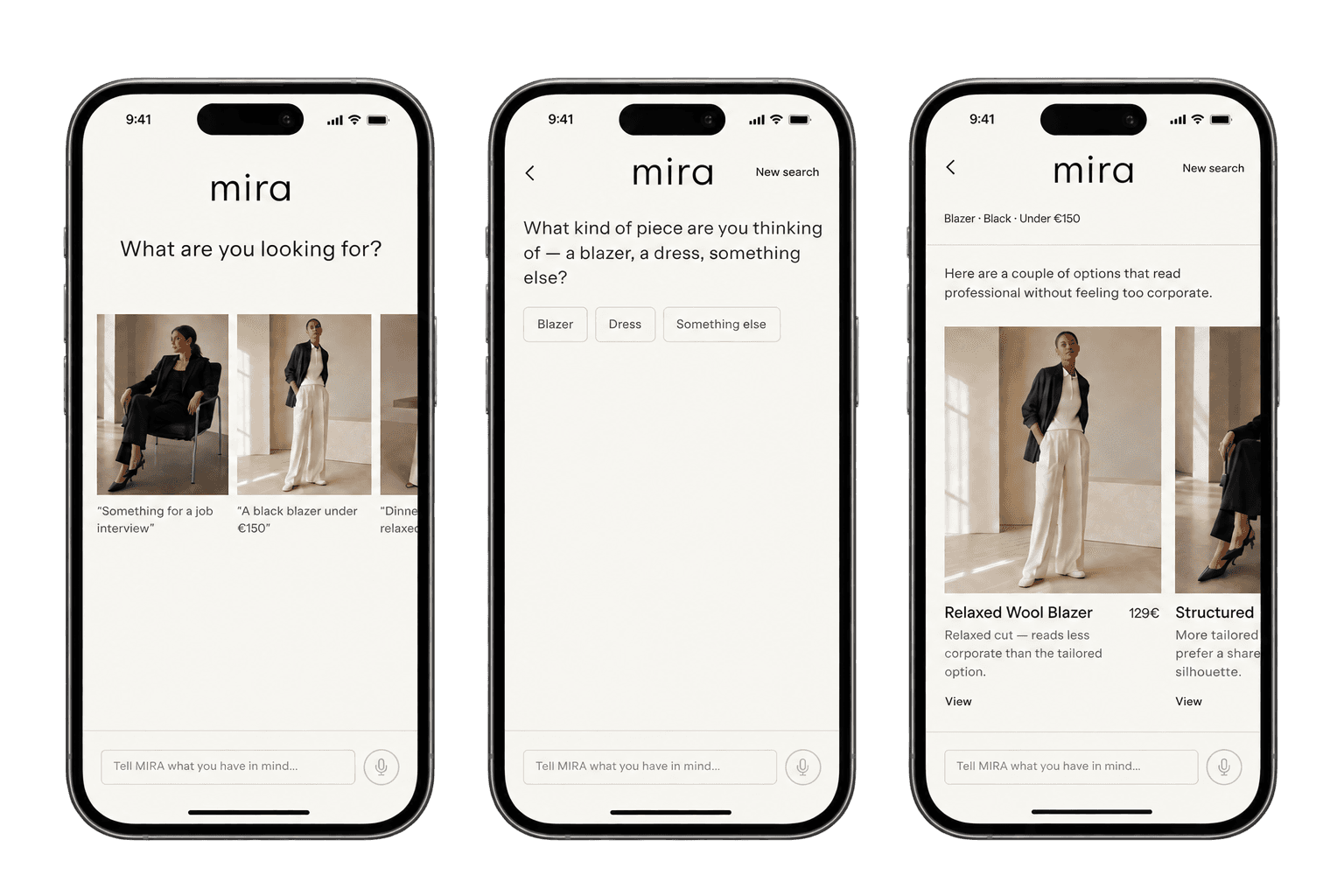
The visual system brings MIRA’s conversational logic into a restrained, product-first experience across desktop, tablet and mobile.
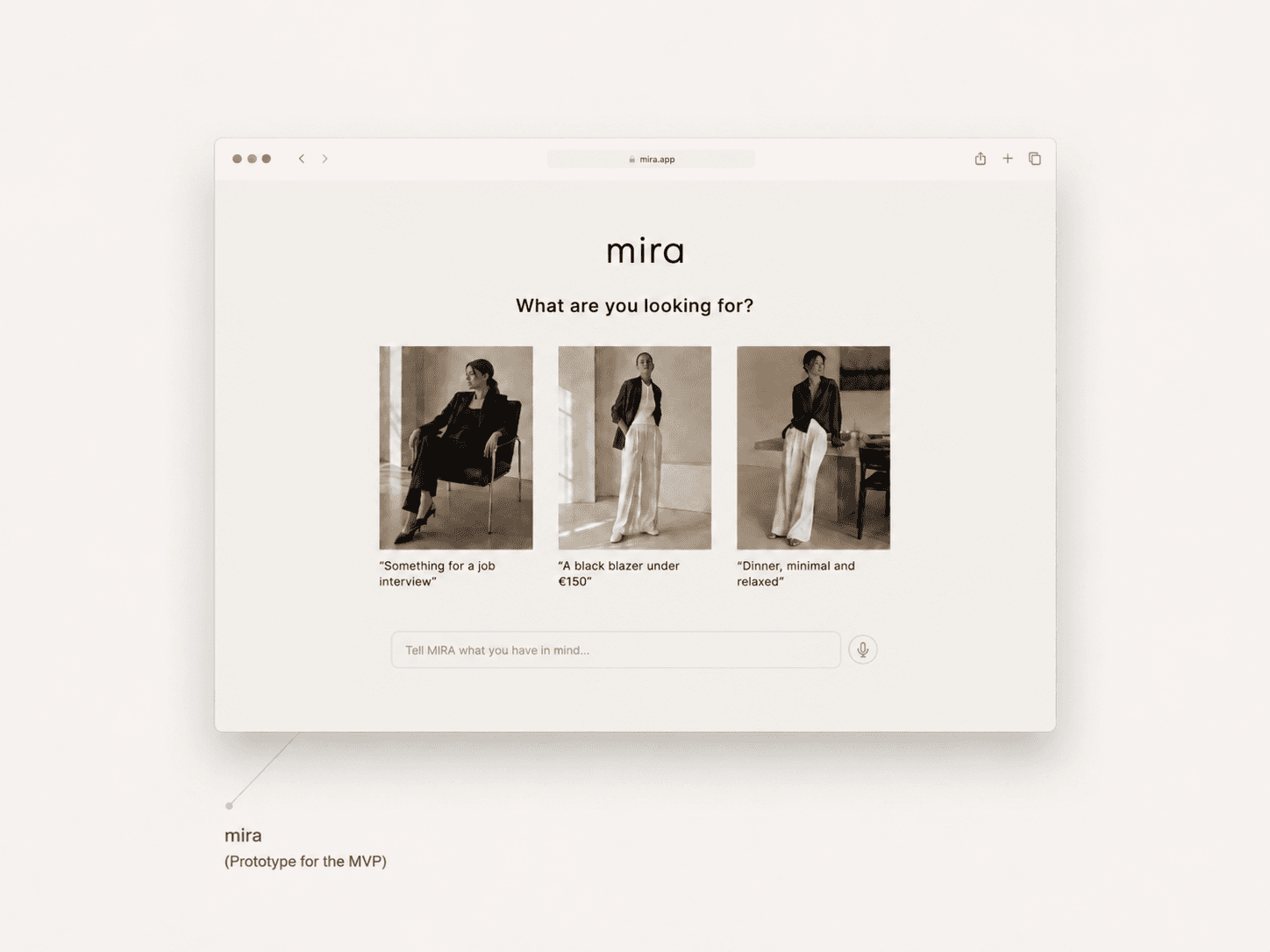
One system, across screens.
WHAT I’M TESTING
The goal isn’t to replace ecommerce navigation, but to understand where conversation adds value — and where traditional interface patterns work better.
Relevance — How quickly can MIRA reach a useful recommendation?
Context — How much information is enough before retrieving products?
Clarification — When does asking improve the result rather than interrupt the flow?
Refinement — Do follow-up requests feel like a continuation rather than a new search?
CURRENTLY BUILDING
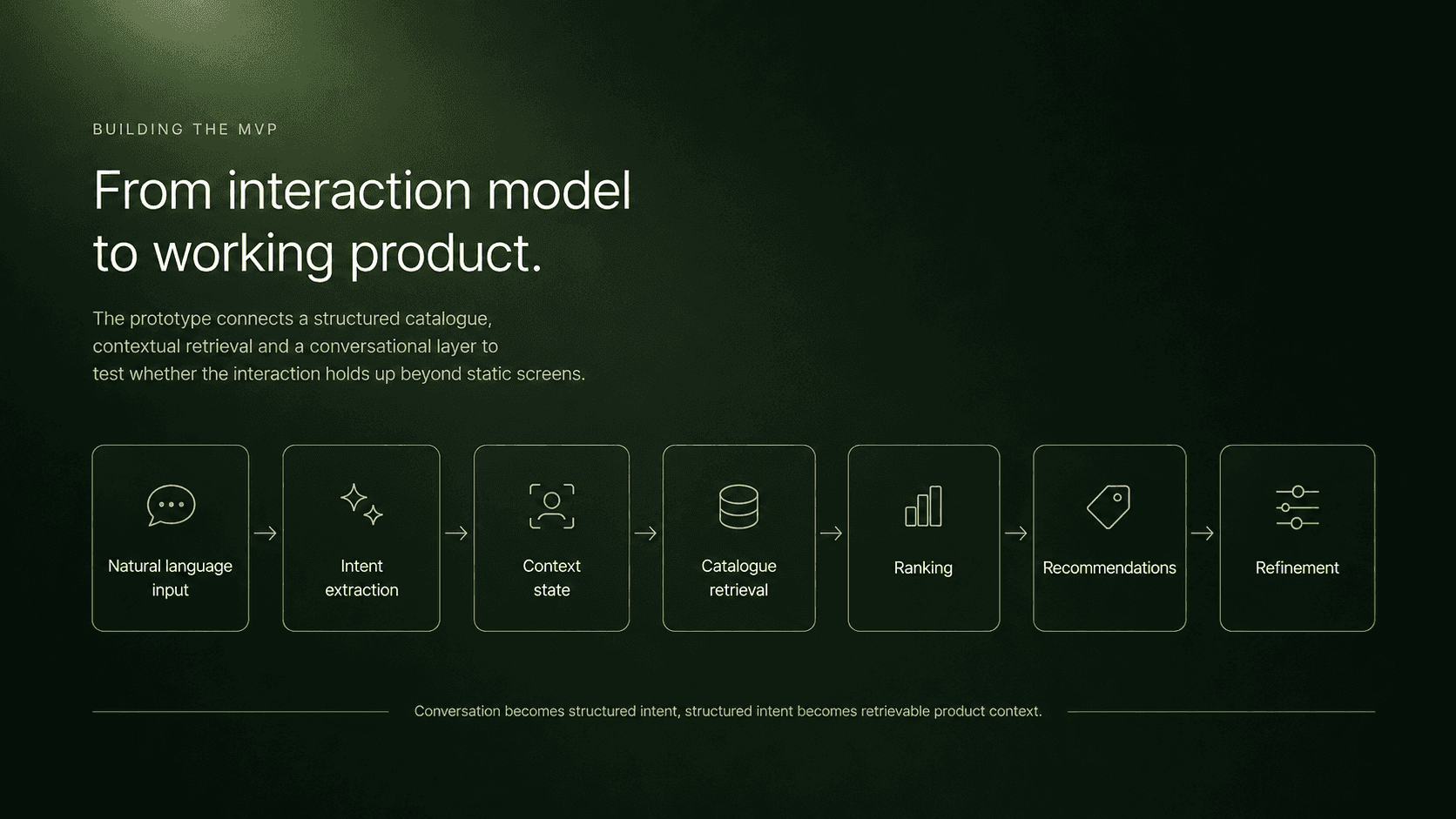
MIRA is moving from concept to prototype.
I’m turning the interaction model into a working MVP using a structured product catalogue, contextual retrieval and conversational interaction.
CONVERSATIONAL PROTOTYPE
Talk to MIRA ↗
Explore the voice interaction while the full product experience is being built. Prototype powered by ElevenLabs.
year
2026
timeframe
In progress
tools
Figma · Claude · ElevenLabs · Supabase
category
Personal Project